
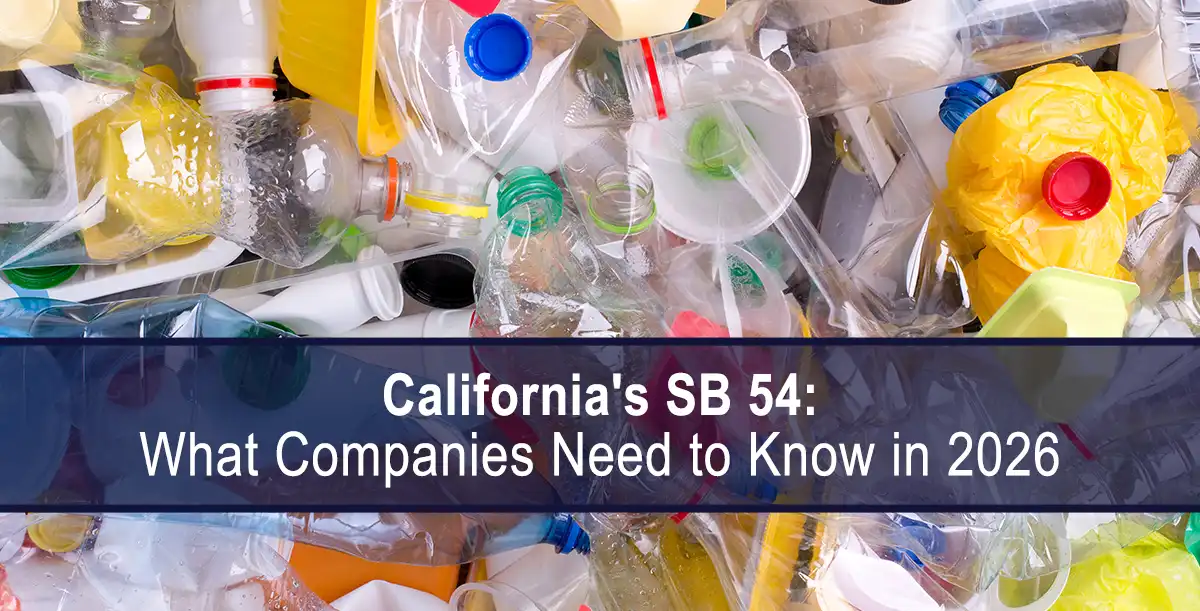
The clock is ticking on California's ambitious plastics reduction law, Senate Bill (SB) 54. While the regulatory agency, CalRecycle's recent withdrawal of proposed regulations might seem like a reprieve, the implementation timeline remains unchanged. For many companies, 2026 is the year to act.
Beyond Compliance: A Strategic Imperative
SB 54 represents a fundamental shift in how we think about packaging and corporate responsibility in the circular economy. The law has a dual mandate, a 25% reduction in single-use plastic packaging by weight and 100% recyclability or compostability.
At its core, SB 54 is an extended producer responsibility (EPR) framework that redefines who bears responsibility for packaging waste. Retailers and food service operators who once viewed themselves as intermediaries are now squarely accountable. If you're selling, offering for sale, or distributing covered materials in California, you're a producer under this law, whether you manufactured the packaging or not. The threshold for exemption from SB 54 is also quite low. Only producers with under $1 million in annual revenue are able to apply for an exemption.
The Data Challenge
The most underestimated aspect of SB 54 is the data complexity. Companies must track both plastic weight and the number of individual plastic components. A seemingly simple takeout container requires identifying, categorizing, and weighing each component: the lid, hinge, label, and tamper-evident seal. Multiply this across thousands of SKUs and evolving product lines and you get an idea of the amount of work involved in complying.
The organizations that will succeed are building robust data infrastructure now, establishing systems that can capture supplier specifications, track changes over time, and support both internal decision-making and external verification.
The Supplier Relationship Revolution
SB 54 is forcing a reimagining of supplier relationships. Suppliers must now be partners in compliance, providing detailed specifications on material composition, component breakdowns, and plastic weights. Forward-thinking companies are already engaging suppliers to discuss redesign opportunities. The most valuable conversations in 2026 won't be about price. They’ll be about collaborative innovation to reduce plastic components and achieve recyclability.
The Path Forward
When companies begin demonstrating reductions in 2027, the winners will be those who treated compliance as a strategic initiative. This means using 2026 to pressure-test assumptions, validate data collection methods, and establish documentation trails. It means building reduction roadmaps that systematically eliminate unnecessary plastic components. And it means investing in reporting infrastructure that will last.
California's approach to regulation rarely stays in California. As the world's fourth largest economy, the state sets standards that ripple nationwide. More fundamentally, SB 54 represents a societal shift in expectations around packaging waste. The businesses that embrace this transition will build trust that extends far beyond regulatory compliance.
The work to be done in 2026 is clear - lock down producer determinations, finalize 2023 baselines, categorize covered materials, build reporting infrastructure, engage suppliers, and identify reduction opportunities. These aren't separate compliance tasks; they're interconnected steps in a fundamental business transformation.
Packaging is at an inflection point. The companies that recognize SB 54 as a catalyst for innovation rather than merely a compliance burden will emerge stronger, more competitive, and better positioned for a future where plastic reduction isn't optional. These aren't separate compliance tasks. They're interconnected steps in a fundamental business transformation.
About Full Scope Insights
Full Scope Insights helps middle market companies navigate moments of complexity, transition, and transformation with clarity and confidence.
Whether facing regulatory shifts like SB 54, preparing for growth, managing risk, or strengthening operations, we partner with leadership teams to turn compliance requirements and strategic challenges into structured, practical action plans.
Our fractional and fit-for-purpose advisory model delivers senior-level expertise in sustainability, human capital, finance, and operational strategy without unnecessary overhead. We focus on building durable systems, strengthening decision-making infrastructure, and positioning organizations for long-term value creation.
Because today’s regulatory and market pressures are not temporary disruptions. They are catalysts for smarter, more resilient businesses.
Learn more at www.fullscopeinsights.com
Marisa Flower,
Sustainability Director
Full Scope Insights