
Why GHG Reporting Matters Now More Than Ever
Companies investing in GHG emissions reporting today aren’t doing so merely to meet regulatory requirements, they are gaining a measurable competitive edge. As the global economy shifts toward transparency and carbon accountability, early movers in scope 1, 2, and 3 reporting unlock operational efficiencies, reduce financing costs, strengthen customer relationships, and protect long-term enterprise value. The question is no longer whether your organization should track emissions, but how quickly you can build the capability before competitors leave you behind.
How GHG Reporting Uncovers Operational Inefficiencies and Reduces Costs
One of the most compelling benefits of scope 1, 2, and 3 GHG emissions reporting is its ability to illuminate operational inefficiencies that directly impact your bottom line. When companies conduct detailed GHG inventories, they create a digital map of energy usage, fuel consumption, and highlight operational inefficiencies across facilities, fleets, and supply chains. This level of visibility often uncovers 10–20% cost savings in electricity, natural gas, transportation, refrigerants, and equipment utilization. These savings frequently exceed the cost of reporting by multiples.
Consider the data: an IEA analysis revealed an average of 11% energy savings across 300 operational energy case studies. This is not uncommon – scope 1 and 2 inventories typically uncover double-digit energy savings, especially for first-time reporters.
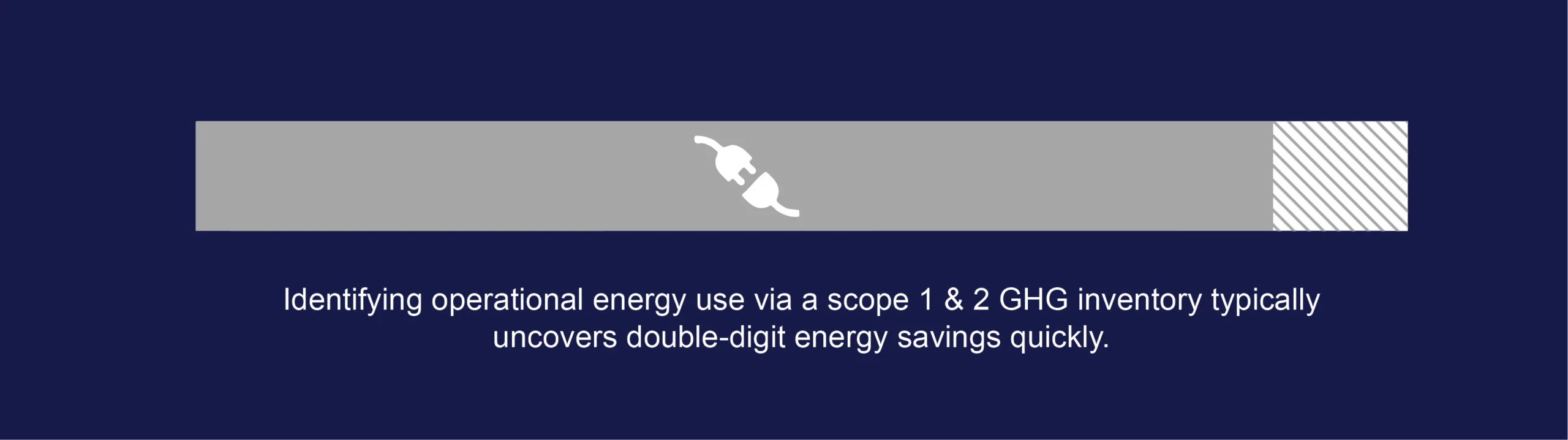
For individual companies, this means identifying leakage in heating, cooling, transportation, and production processes that would otherwise remain invisible without systematic emissions measurement.
Customers Now Require GHG Disclosure: Supplier Expectations Are Changing
Large enterprises now integrate emissions data into procurement, supplier vetting, and long-term contracts. Across all industries, the largest players such as Walmart, Amazon, Apple, GM, Ford, Schlumberger, NVIDIA, Lockheed Martin, Johnson & Johnson, PepsiCo, FedEx, Delta, and AT&T require suppliers to disclose emissions and reduction plans.
Some Fortune 500 companies now only accept bids from vendors with verifiable scope 1 & 2 emissions baselines and mandate disclosure through portals such as CDP. Energy, industrial, and technology buyers increasingly require emissions disclosure before awarding contracts or renewing master service agreements (MSAs). This means that organizations lacking credible emissions data are being screened out of proposal requests, supplier portals, and contract renewals before price or technical capabilities are even considered.
For B2B companies, especially in manufacturing, logistics, energy, and technology, failure to disclose is no longer neutral. It’s a competitive disadvantage. In dozens of industries, emissions reporting is now as fundamental as financial reporting in winning enterprise business.
Lower Cost of Capital Through High-Quality Emissions Reporting
Capital markets are continuing to send a clear signal: carbon disclosure and emissions management are no longer “ESG add-ons”, they are financial variables that can influence a company’s cost of capital. Investors, lenders, insurers, and credit-rating agencies are increasingly pricing carbon risk into their models, and the empirical evidence is now clear. Companies with higher emissions or weak disclosures face higher financing costs, while organizations with credible reduction strategies, transparent reporting, and third-party assurance benefit from lower risk premiums and improved access to capital.
A growing body of academic research supports this trend:
Carbon-intensive firms experience higher financing costs.
A 2024 multi-year study of Australian-listed firms found that carbon-intensive companies exhibit significantly higher idiosyncratic risk and experience measurable increases in both the cost of equity and cost of debt. The authors concluded that “each additional metric ton of carbon emissions results in an average 18.5% higher cost of capital,” highlighting the direct financial penalty associated with unmanaged emissions.
Markets reward credible emissions reduction and verified reporting.
A study published in the Journal of International Accounting, Auditing, and Taxation found that firms with a greater number of emissions-reduction initiatives, paired with assured carbon disclosures, benefited from lower borrowing costs. Companies without verified disclosures or lacking demonstrable mitigation actions faced materially higher costs of debt.
Global evidence shows a consistent pattern.
Additional research aligns with these findings:
-
- MSCI, S&P Global, and Moody’s have all incorporated emissions intensity and climate-transition preparedness into credit ratings, with clear evidence that poor carbon performance can lead to ratings pressure or increased insurance premiums.
- McKinsey indicates that, of over 2,000 recent academic studies examining the relationship between positive ESG performance and cost of capital, 70% of those found a positive correlation between the two, resulting in about a 10% lower cost of capital for companies performing better in sustainability.
Policy and investor mandates reinforce the trend.
The EU’s CSRD proposed rules, California’s SB 253/261, and the rapid standardization of climate reporting under the ISSB have accelerated institutional demand for consistent emissions transparency. Investors representing trillions of dollars (e.g., BlackRock, State Street, Norges Bank, and the UN PRI network) have publicly stated that climate governance and emissions metrics are material to valuation and investment allocations.
Scope 3 Emissions: The Key to Supply Chain Resilience and Strategic Advantage
The true magnitude of most companies' carbon footprint lies not within their own operations but throughout their supply chains. Scope 3 emissions, those generated up and down the value chain, typically represent 90%+ of total emissions for companies in most sectors.
This reality transforms emissions reporting from a compliance exercise into a strategic supply chain initiative. When organizations undertake scope 3 measurements, they gain visibility into supplier performance, identify concentration risks, and uncover opportunities for collaborative improvement. In our experience, as much as 80% of an organization's supply chain emissions come from just 10% of its purchases, enabling targeted engagement that delivers outsized impact.
The competitive implications of scope 3 accounting and action can be substantial. Organizations that achieve simultaneous increases in revenue, reductions in supply chain costs, and decrease of scope 3 emissions, can position themselves for sustained market leadership.
GHG Reporting as a Driver of Revenue, Market Access, and Customer Preference
Consumer behavior continues to shift decisively toward sustainability-conscious purchasing decisions. Currently, global consumers indicate a willingness to pay 9.7% more for sustainable brands, as 85% of survey respondents have personally felt the impacts of climate change.
For B2B organizations, the pressure is equally intense. With 24% of supply chain professionals increasing sustainability and CSR prioritization over the next 12-18 months (compared to 19% in the previous year), companies without credible emissions data increasingly find themselves excluded from procurement processes before discussions about price or performance even begin. This represents an erosion of addressable market that many executives underestimate.
First-Mover Advantage: Building Internal Capabilities
Establishing an auditable emissions inventory, particularly for complex scope 3 categories, requires developing new competencies, establishing data collection infrastructure, building supplier relationships, and fostering cross-functional collaboration. Companies that report gain a significant learning-curve and process advantage. By the time climate reporting becomes universally required, early movers will have established data pipelines, trained internal teams, strengthened supplier engagement, and refined methodologies through multiple reporting cycles. Late adopters may face steep catch-up costs, often under regulatory pressure or audit scrutiny.
Conclusion
In a world where emissions transparency increasingly drives capital access, customer trust, regulatory compliance, and competitive advantage, businesses cannot afford a reactive approach. Companies that build high-quality, verifiable GHG inventories today will reduce financial risk, improve operational performance, and position themselves for long-term success. Emissions reporting is more than responsible governance: it is a strategic investment that strengthens the entire enterprise.
How to Start Your GHG Reporting Journey (And Why Expert Support Matters)
The strategic case for early GHG emissions reporting is compelling across every dimension that matters to business leadership. Yet the complexity of establishing a comprehensive, auditable, and strategically valuable emissions measurement program should not be underestimated. This is where strategic partnership with a GHG emissions consultant becomes essential.
About Full Scope Insights and Our GHG Emissions Accounting Services
Looking to establish your GHG baseline or improve current reporting practices? Let’s talk.
FSI Consulting delivers sophisticated GHG emissions consulting the kind that fuels real growth, ensures robust compliance, and builds enterprise value, without breaking the bank.
Our team brings the technical expertise, industry knowledge, and practical experience to guide you through every phase of your emissions journey, from initial boundary setting through data collection infrastructure, supplier engagement, verification readiness, and strategic reduction planning.
Ethan Krohn,
Manager, Sustainability & GHG Emissions
Full Scope Insights